


Without a mechanism to regulate cross-strait negotiation and safeguard local industries, the livelihoods of millions of Taiwanese will be at stake if the government pushes the cross-strait service trade agreement between Taiwan and China through the legislature, hundreds of protesters said yesterday.
“If [the pact] is not screened clause-by-clause, we’ll fight to the very end,” Chen Chih-ming (陳志銘), president of the Kaohsiung Federation of Labor Unions, told protesters, who braved low temperatures and wind to gather in front of the Presidential Office on Ketagalan Boulevard in Taipei.
The protesters demanded that several pieces of legislation be passed to ensure transparency and democratic principles before the pact is screened by the Legislative Yuan.
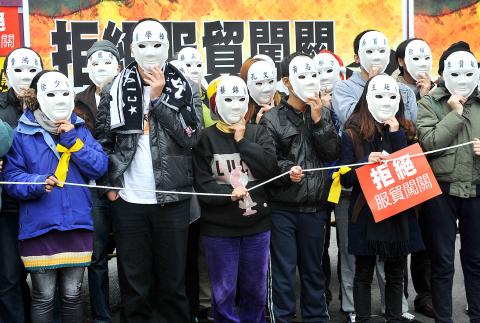
Photo: Chien Jung-fong, Taipei Times
They include a statute to regulate all agreements and treaties made between Taiwan and China; a bill to regulate incoming Chinese investment and workers; and a bill to institutionalize the impact assessment review of free trade.
Without such a safeguard mechanism, the jobs and wages of millions of local workers could suffer, particularly because neither local business sectors nor the legislature had been informed about the contents of the pact before it was signed in June, representatives who spoke at the rally said.
The potential negative impact of the deal has been a serious concern not only for workers, but also for students and youth rights advocates.
“The agreement could be summed up in two words: undemocratic and unfair,” said Chiu Yu-bin (邱毓斌), president of the Taiwan Association for Human Rights.
The signing of the pact was “not democratic” because neither the public nor the legislature had been consulted. The pact would only benefit large corporations, he said.
“I would say that the KMT has been kidnapped by those large corporations and the signing of the pact has launched a new wave of class struggle between rich and poor,” Chiu added.
Aphrodite Hung (洪瑞璞), spokesperson of the Black Island Nation Youth Front (黑色島國青年聯盟), said it was unfair to have the future of millions of Taiwanese decided by only a handful of business tycoons and an administration that has been doing nothing but what Beijing wanted from it since 2008, when President Ma Ying-jeou (馬英九) took office.
Although the KMT has withdrawn its original plan to forcibly pass the deal in an extra legislative session next month, the protesters remain suspicious, fearing that the party could launch an “ambush.”
KMT lawmakers refused to fill in a questionnaire prepared by the Democratic Front Against Cross-Strait Trade in Services Agreement, which asked every lawmaker to state his or her position on the protesters’ demands, alliance spokesperson Lai Chung-chiang (賴中強) said.
Only 44 of the 113 lawmakers filled in the questionnaire, with one coming from the People First Party, three from the Taiwan Solidarity Union and all 40 Democratic Progressive Party legislators, Lai said.
At a separate protest earlier, dozens of members of the Alliance of Referendum for Taiwan gathered in front of the legislature at noon, saying that the opposition should cite Article 16 of the Economic Cooperation Framework Agreement (ECFA) and demand the termination of the pact.
Under Article 16 of the ECFA, Taiwan and China would have to hold negotiations within 30 days after a side gives written notice of its intention to terminate the agreement.
Should there be a lack of consensus, each side must wait 180 days before the ECFA is terminated.
“Since the service trade pact is part of the ECFA, we assume that this would be the most effective way to stop the agreement,” alliance spokesperson Chang Ming-yu (張銘祐) said.

The National Chungshan Institute of Science and Technology yesterday showcased its locally developed variants of the Vision 60 robotic patrol dog, which it plans to deploy on the nation’s outlying territories in the South China Sea. The variants were produced under the Joint Lab project — created by the institute and domestic companies — and assembled with domestically produced motors, lenses and artificial intelligence (AI) systems alongside licensed tech from the US, Missile and Rocket Systems Research Division deputy director Jen Kuo-kang (任國光) told the media event at a military base in Taipei’s Dazhi (大直) area. Taiwan has built up its strengths

RIGHT DIRECTION: Taiwan’s efforts to prevent forced labor include a proposal to ‘fully prohibit’ employers from withholding workers’ documents, an official said Taiwan is to establish a mechanism to restrict imports of goods linked to forced labor, the Executive Yuan said yesterday, after the US proposed imposing additional tariffs on Taiwanese goods over labor concerns. “The Ministry of Labor and the Ministry of Economic Affairs are to establish an interministerial review procedure,” Executive Yuan spokesperson Michelle Lee (李慧芝) said at a news briefing in Taipei. “The government is to use the Foreign Trade Act [貿易法] as the legal basis to restrict imports of goods produced with forced labor” and bring its supply chain governance more in line with international standards on human rights, resilience

NOT IMMEDIATE: Taiwan has a chance to appeal the proposed 10 percent tariff before it starts, while other countries face a 12.5 percent tariff from the trade office Taiwan is among 60 economies determined by the US to have failed to impose or enforce a ban on the importation of goods produced with forced labor, according to a notice released on Tuesday by the Office of the US Trade Representative (USTR), which proposed imposing an additional 10 percent or more tariff on them. The USTR in a statement said that following an investigation, it had determined under Section 301 of the Trade Act of 1974 that the failure of the 60 economies to impose and effectively enforce a prohibition on the importation of goods produced with forced labor is

TIT-FOR-TAT: The US allegedly revoked the visa of a Chinese national working at Xinhua News Agency in the US in response to Beijing’s expulsion of Vivian Wang The Presidential Office yesterday condemned China for expelling a New York Times correspondent from Beijing following the newspaper’s interview with President William Lai (賴清德), saying the move highlighted Beijing’s suppression of press freedom and its threat to international news media. Taiwan has noted a series of recent incidents in which Beijing used similar tactics to “threaten and pressure international media outlets and journalists,” Presidential Office spokeswoman Karen Kuo (郭雅慧) said in a statement. “This concerns not only press freedom and freedom of expression, but also the safety of journalists, and Taiwan and relevant partners are paying close attention to the situation,” she


 RSS
RSS